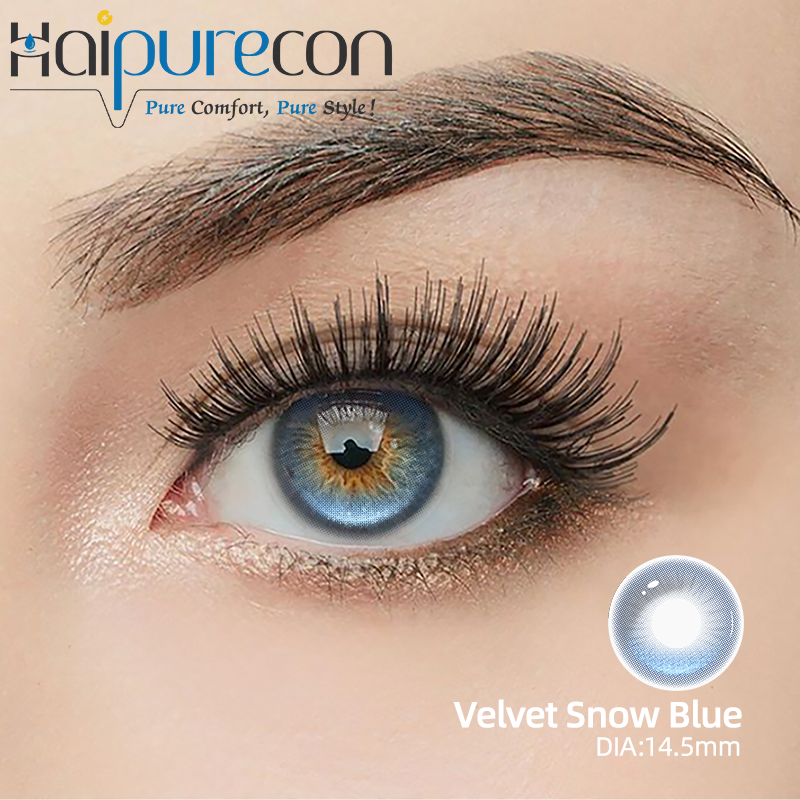
Purchasing colored contacts only to have them look muddy, artificial, or completely invisible against dark brown irises is a common consumer frustration. Blue is notoriously the most difficult color to achieve on dark eyes. Because cool blue sits opposite warm brown on the color spectrum, the visual transition is starker and much harder to blend than hazel or green. Dark chocolate brown eyes possess high levels of melanin, which absorbs light rather than reflecting it, rendering standard translucent colored lenses ineffective.
Achieving a natural blue look requires specific manufacturing techniques. Success depends on high-opacity pigments, multi-tone printing, base pigment neutralization, and precise pupil blending. We will break down the optical challenge of color blending and introduce the technical framework for evaluating colored lenses. You will learn exactly how to select lenses that deliver a vibrant, realistic transformation without compromising eye health or visual clarity.
Opacity is Non-Negotiable: Standard enhancement tints fail on dark eyes; only high-opacity, opaque-tinted lenses can block the underlying brown melanin.
Base Pigments Matter: The underlying base pigment of the lens must actively neutralize the warm tones of dark brown eyes to prevent the blue from turning green or grey.
Pupil Blending Dictates Realism: The transition zone between the lens's clear center and the colored pigment determines whether the lens looks natural or creates a harsh, artificial ring.
Material Dictates Wearability: The choice between daily blue contact lenses and long-term wear options impacts both eye health (oxygen permeability) and pigment vibrancy.
Safety Over Aesthetics: FDA-approved materials utilizing "sandwich" pigment technology are mandatory to prevent corneal damage from color dyes.
The Physics of Color Changing: Why Standard Lenses Fail on Dark Eyes
A successful color change must completely cover the brown iris without compromising visual acuity. It should add natural depth and intrigue to the gaze rather than looking like a flat, printed sticker. Understanding why standard lenses fail requires a close look at how human eyes interact with light at a structural level. The color of your eye is determined by the amount and distribution of melanin in the stroma, the thickest layer of the iris. When light enters a dark brown iris, the dense melanin granules act like a sponge. They absorb almost all the incoming light rays. Translucent lenses, often marketed as "enhancement tints," lack the pigment density to block this absorption. Instead of covering the brown, they act like a watercolor wash over a black canvas.
This mixing creates a significant optical problem due to basic color theory. Warm dark chocolate brown easily overpowers cool blue tones. When a translucent blue layer sits over a dark brown base, the resulting color is rarely blue. It usually shifts into an undesirable muddy green or a dull, flat grey. The warm tones of the melanin actively fight against the cool tones of the lens. Unless the lens utilizes a neutralizing base layer, the brown will always dominate the visual output.
The baseline requirement for Blue Contacts for Dark Eyes is a solid, opaque pixelation pattern. Opaque tints are engineered specifically to reflect light outward. They create a physical barrier that prevents the brown base from showing through the colored portion of the lens. Manufacturers achieve this by printing dense, micro-dot matrices onto the lens surface. These dots are packed tightly together to form a solid wall of color, completely masking the melanin beneath them while still leaving microscopic gaps to allow oxygen to pass through to the cornea.
To truly neutralize the dark background, high-quality opaque lenses often employ a primer layer. Just as a painter uses a white primer on a dark wall before applying a bright color, lens manufacturers use a neutral or slightly warm base pigment to block the brown. Once the brown is neutralized, the cool blue pigments can be layered on top, allowing them to show their true, vibrant color without interference from the natural iris.
Key Evaluation Dimensions: Selecting Blue Contacts for Dark Eyes
Finding the right lenses involves evaluating several technical dimensions beyond just picking a shade you like. High-opacity pigmentation density is the primary factor. Pigment density grading determines how much natural eye color is blocked. Manufacturers layer opaque colors to completely mask dark irises, but they must balance this density carefully. Applying too much pigment makes the lens thick, stiff, and uncomfortable to wear. The base pigments used in this layering process determine the final look, acting as a primer to neutralize the brown before the primary blue color is applied.
Multi-tone printing technology separates premium lenses from cheap alternatives. Single-tone lenses use one flat color across the entire iris. This creates a highly artificial look because human eyes are naturally multi-dimensional. To mimic the natural radial depth of a human iris, manufacturers use advanced printing techniques.
The Outer Ring: A dark limbal ring defines the edge of the iris, making the eye look larger and more youthful.
The Mid-Tone: The primary blue color provides the main aesthetic transformation, utilizing dense micro-dots to block the brown.
The Inner Ring: A warm inner ring (often hazel or gold) sits near the pupil. This layer bridges the cool blue to the warm brown pupil center, creating a seamless gradient.
The pupil opening diameter requires careful consideration. There is a strict trade-off in pupil hole sizing. A small opening (around 4.0mm) hides the brown iris almost completely, but it can restrict vision in low light when your natural pupil dilates beyond the clear center of the lens. A large opening (around 5.5mm) improves night vision but exposes a stark brown ring around the pupil, ruining the illusion. The best lenses solve this with a feathered or gradient inner edge. This design seamlessly blends the blue pigment into the natural brown center, eliminating harsh lines regardless of how much your pupil dilates.
Limbal ring design drastically alters the final aesthetic. The limbal ring is the dark outer edge of the iris. Lenses with sharp, thick limbal rings create an enlarging, doll-like effect popular in cosplay or specific beauty trends. Soft, blended limbal rings maximize natural realism by gently framing the eye. Many users prefer "No Limbal Ring" designs for achieving the most realistic, seamless blue transformation on very dark eyes. These designs blend directly into the sclera (the white of the eye), mimicking the natural appearance of light-colored eyes.
Limbal Ring Style
Visual Effect
Best Use Case
Thick / Solid
Enlarges the eye, creates a bold, doll-like appearance.
Blends directly into the sclera, highly realistic.
Maximum realism on very dark brown eyes.
Solution Categories: Daily Blue Contact Lenses vs. Extended Wear
Choosing the right replacement schedule impacts both your budget and your eye health. Daily Blue Contact Lenses offer the highest hygiene standards available. You wear them once and throw them away. This eliminates protein and lipid buildup, which can cloud colored pigments over time and cause irritation. Daily lenses use thinner materials, providing immediate comfort upon insertion. They require zero maintenance, making them highly convenient for occasional wearers, travelers, or those with sensitive eyes. However, the thinness of the daily material sometimes limits the application of extreme high-opacity, complex multi-tone designs, as the lens can only hold so much pigment before becoming too thick for daily disposable standards.
Monthly and yearly lenses cater to frequent wearers. They feature thicker materials capable of holding denser, more complex multi-tone pigments. This makes them ideal for achieving maximum opacity on very dark eyes. If you wear colored contacts every day, extended wear lenses are generally more cost-effective. The downside is the strict maintenance required. You must clean, rinse, and store them properly every night using appropriate contact lens solutions. Extended wear lenses carry a higher risk of lipid and calcium buildup. Over time, these deposits degrade the blue pigment, reduce oxygen permeability, and increase the risk of corneal infections if hygiene practices slip.
When managing extended wear lenses, the cleaning routine is non-negotiable. You must physically rub the lenses in the palm of your hand with solution to break up protein deposits. Relying solely on "no-rub" solutions often leaves microscopic debris on the colored pigment, which dulls the blue effect and irritates the eyelid. For maximum safety and color longevity, many optometrists recommend hydrogen peroxide cleaning systems for monthly or yearly colored lenses, as they provide a deeper clean than standard multi-purpose solutions.
Feature
Daily Lenses
Monthly/Yearly Lenses
Hygiene & Safety
Maximum (fresh pair daily, zero buildup)
Requires strict daily cleaning regimen
Opacity & Design
Good, but sometimes limited by thin material
Excellent, thicker material holds dense pigments
Maintenance
Zero maintenance required
Requires solutions and proper storage cases
Comfort
High initial comfort, very thin
Can become dry if protein builds up over time
Overall Value Influencing Factors: Comfort, Fit, and Material Science
The material science behind Blue Contact Lenses dictates how long you can safely wear them. Oxygen permeability, measured as Dk/t, is a vital metric. Standard hydrogel materials rely on water content to transmit oxygen to the cornea. Modern silicone hydrogel materials allow oxygen to pass directly through the polymer, regardless of water content. Opaque pigments physically block oxygen flow because the micro-dots create a barrier. Therefore, selecting high Dk/t materials is critical, especially for extended wear. Starving the cornea of oxygen leads to hypoxia, which causes redness, swelling, blurred vision, and severe long-term damage like corneal neovascularization (where new blood vessels grow into the clear cornea).
A proper fit is essential for colored lenses. The Base Curve (BC) measures the curvature of the lens, typically ranging from 8.4mm to 8.9mm. The Diameter (DIA) measures its width across, usually between 14.0mm and 14.5mm. Human eyes are not perfectly spherical; they vary in steepness and size. A poorly fitted lens will slide off-center every time you blink. When a colored lens decenters, it instantly reveals the brown eye underneath, completely ruining the illusion. It also causes physical discomfort, a sensation known as "lens awareness," and can scratch the corneal surface.
Manufacturing safety must be your top priority. The evaluation criteria must mandate lenses utilizing pigment sandwich technology. In this manufacturing process, the color pigment is encapsulated between two clear layers of lens material. The toxic dyes never actually touch the surface of your eye or your eyelid. Cheap, unregulated lenses often print the color directly on the surface. This allows the pigment to rub off against your eyelid or cornea, leading to severe allergic reactions, giant papillary conjunctivitis (GPC), infections, and permanent vision loss.
You can often test for surface printing by gently rubbing a cotton swab over the surface of a discarded lens. If any blue pigment transfers to the swab, the lens lacks sandwich technology and is unsafe for wear. Always stick to reputable brands that explicitly state their use of encapsulated pigment manufacturing.
Implementation Risks and Mitigation Strategies
The colored contact lens market is flooded with misleading marketing. The most common trap is relying solely on manufacturer stock photos. Brands frequently alter these images digitally to make the colors look impossibly vibrant and to completely erase the underlying brown eye. To mitigate this, seek out independent video try-ons. Watch reviews of specific blue lenses on very dark brown eyes. Video swatches under natural lighting verify the true opacity and color payoff before you commit to purchasing. Pay attention to how the lens looks when the reviewer looks to the side, as this reveals how well the lens blends with the natural pupil.
Another common issue is the "bug eye" effect, caused by a graphic diameter mismatch. You must differentiate between the total lens diameter and the graphic diameter. The total diameter is the physical size of the lens. The graphic diameter is the size of the printed color portion. Choosing a graphic diameter significantly larger than your natural iris creates an alien-like, enlarging effect. Unless you are specifically aiming for a theatrical or "circle lens" look, keep the graphic diameter close to your natural iris size (usually around 13.0mm to 13.5mm) for realistic results.
Counterfeit and unverified retailers pose a massive risk to eye health. Unregulated colored contacts sold at beauty supply stores, costume shops, or unverified online vendors frequently bypass safety testing. They often use toxic industrial dyes and lack sterile packaging. Always verify that the lenses have FDA approval or a legitimate CE marking. Check the packaging for clear lot numbers, expiration dates, and crisp printing. If a retailer does not require a prescription verification in regions where it is mandated by law, they are operating illegally and selling potentially dangerous products.
Skipping the optometrist fitting is a dangerous shortcut. Even individuals with perfect 20/20 vision require a prescription for plano (non-corrective) colored lenses. An eye care professional must measure your base curve and diameter to ensure a safe fit. They will also evaluate your tear film and corneal health to confirm you are a suitable candidate for contact lens wear. Wearing improperly sized lenses can cause corneal abrasions, ulcers, and irreversible damage. A lens that is too tight will choke off oxygen, while a lens that is too loose will cause constant friction.
Conclusion
Achieving a clear, vibrant blue color on dark brown eyes is entirely possible and can add remarkable depth to your gaze. Success relies strictly on the physics of high-opacity, multi-tone pigment layering rather than standard translucent color tints. By understanding how melanin absorbs light and how base pigments neutralize warm tones, you can bypass ineffective products and choose lenses engineered specifically for dark eyes. Prioritize lenses that feature 3-tone printing or no-limbal-ring designs, and look for a feathered pupil opening to ensure a smooth transition from the blue pigment to your natural brown center.
Take the following steps to ensure a safe and successful color transformation:
Schedule a comprehensive contact lens fitting with an optometrist to obtain your precise Base Curve and Diameter measurements.
Search for independent video reviews of your chosen lens model specifically demonstrated on dark brown eyes to confirm real-world opacity.
Start by purchasing a small supply of daily disposable lenses to test the color suitability and material comfort before committing to a yearly variant.
Verify that the manufacturer uses encapsulated pigment technology to protect your cornea from direct contact with dyes.
Purchase exclusively from verified retailers that stock FDA-approved or CE-marked brands and require prescription verification.
FAQ
Q: Why is blue the hardest color to achieve on dark brown eyes?
A: Dark brown eyes have high melanin, which absorbs light. Cool blue sits opposite warm brown on the color wheel. When a translucent blue lens is placed over a dark brown iris, the warm tones overpower the cool tones, resulting in a muddy or artificial appearance. Base neutralization is required to block the brown.
Q: Can you really wear blue contact lenses if you have dark brown eyes?
A: Yes, you can. The key is using lenses with opaque tints rather than enhancement tints. High-opacity lenses use dense pixelation patterns to physically block the brown melanin from showing through, allowing the blue pigment to reflect light and show clearly.
Q: What are the best blue contacts for dark eyes?
A: The best options utilize 3-tone designs or no-limbal-ring styles. They should feature a high-opacity base layer to neutralize the brown, a vibrant blue mid-tone, and a feathered inner ring to blend seamlessly into your natural pupil without leaving harsh lines.
Q: Are daily blue contact lenses safer than yearly lenses?
A: Daily lenses are generally safer because they offer the highest hygiene standards. Discarding them after one use eliminates the risk of protein and lipid buildup, which can harbor bacteria and cause eye infections. Yearly lenses require strict, consistent cleaning regimens to remain safe.
Q: Why do my blue contacts look muddy or green?
A: If your lenses look muddy or green, they likely use a translucent tint. Translucent blue mixes with the natural yellow and warm tones of your brown iris. In color theory, mixing blue and warm brown creates green or grey. You need opaque lenses to prevent this mixing.
Q: How do I prevent colored contacts from looking fake?
A: Avoid single-tone flat prints and lenses with overly large graphic diameters, which create a bug-eye effect. Choose 3-tone lenses with a feathered pupil opening and a soft or non-existent limbal ring. Always check video swatches on dark eyes before buying.
Q: Do I need a prescription for colored contacts if I have perfect vision?
A: Yes. Even if you do not need vision correction, you still need a prescription. An optometrist must measure your eye's base curve and diameter to ensure the lens fits properly and will not scratch your cornea or restrict oxygen flow.