You see big opportunities in the contact lens world. The market is booming:
Valued at about USD 11.75 billion in 2025
Expected to hit USD 20.97 billion by 2034
Growing at a fast pace each year
If you want to launch your own brand, you need a strong plan. Focus on business basics, legal rules, and smart marketing. Great marketing helps you stand out and connect with customers.
Key Takeaways
Do careful market research to find trends and needs. This helps you see chances and gaps in the contact lens market.
Make a clear business plan with your goals and customers. Your plan should show how you will market your brand. A good plan helps you stay organized and focused.
Pick good materials and trusted makers for your lenses. This makes sure your lenses are safe and comfortable. It helps customers trust your brand.
Follow all legal rules and get needed certifications and FDA approvals. Doing this keeps your business and customers safe.
Use strong marketing on different channels. Good branding and customer support help you get and keep customers.
Market Research and Business Plan
Analyze the Contact Lens Market
You should begin with good market research. Check out new trends in contact lenses. Smart contact lenses are becoming more popular. They can help monitor health. Daily disposable lenses are wanted for better hygiene. Many people like eco-friendly packaging and materials. Specialty lenses for myopic control and presbyopia are growing. Online sales channels are getting bigger. This makes it easier to reach buyers and increase contact lens revenue.
Tip: Watch what your competitors do. Look at their products, prices, and marketing. This helps you find gaps and chances to grow.
Define Target Customers
Who will buy your contact lens products? Younger people, ages 18 to 34, often pick contact lenses for vision and style. Older adults use contact lenses for age-related vision problems. You should focus on these groups. Think about what they need and how they act. Are they looking for convenience, fashion, or health benefits? Knowing your customers helps you build a strong sales plan. It also boosts your chances of making money.
Develop Your Business Plan
A clear business plan helps guide your brand. Successful contact lens startups use a plan like this:
Step | Description |
1 | Set the Core Idea and Legal Structure |
2 | Study the Market and Customer Profile |
3 | Make the Product and Pricing Plan |
4 | Plan Operations and Logistics |
5 | Create the Marketing and Sales Plan |
6 | Build the Team and Organization |
7 | Make a 5-Year Financial Model |
You need to set your goals and plan your sales strategy. Think about how to grow contact lens revenue. Make sure you know the rules and prescription laws. Position your brand so it stands out. A strong plan keeps you organized and ready to succeed.
Product Development and Manufacturing
Source Materials and Technology
You want your contact lens brand to be different. This starts with choosing the right materials. Most brands use hydrogel or silicone hydrogel for soft lenses. Hydrogel lenses use poly-HEMA. This lets water move through and keeps the lens soft. Silicone hydrogel is a newer material. It lets more oxygen get to the eye. This means more comfort and healthier eyes. You can see the main types of materials in this table:
Material Type | Description |
Glass (hard lenses) | Less comfortable and less permeable to oxygen; not commonly used today. |
Silicone Hydrogel | Soft lenses with high oxygen permeability; popular choice for comfort. |
Hydrogel Monomer Resin | Most popular for soft lenses due to wider application spectrum. |
Rigid Gas-Permeable | Hybrid lenses with a rigid center and softer peripheral fitting zone; generally rare. |
When you pick materials, think about what your customers want. Comfort, how long they can wear them, and oxygen flow are important. People also care about how easy the lens is to use. They want clear vision too. If you want to sell daily disposable lenses, choose materials that stay wet and comfy all day.
Technology is always changing in contact lenses. Now, some lenses have water gradient layers. These feel very light. Some lenses have sensors to track health or change with sunlight. New designs help keep eyes wet and cut down glare. These new things give you more choices for your customers.
Tip: Keep learning about new materials and technology. This helps you make lenses people enjoy wearing.
Partner with Contact Lens Manufacturers
You need a good partner to make your lenses. Find manufacturers who use new technology and follow safety rules. Some companies, like Eyeris, have their own factories in Asia. They use special ways like UV crosslinking to make strong, safe lenses. When you choose a partner, see if they care about the doctor-patient relationship and do the right thing.
Here are some things to look for in a manufacturing partner:
Good reputation for quality and safety
Experience with the latest lens technology
Strong quality control systems
Willingness to share test results and certifications
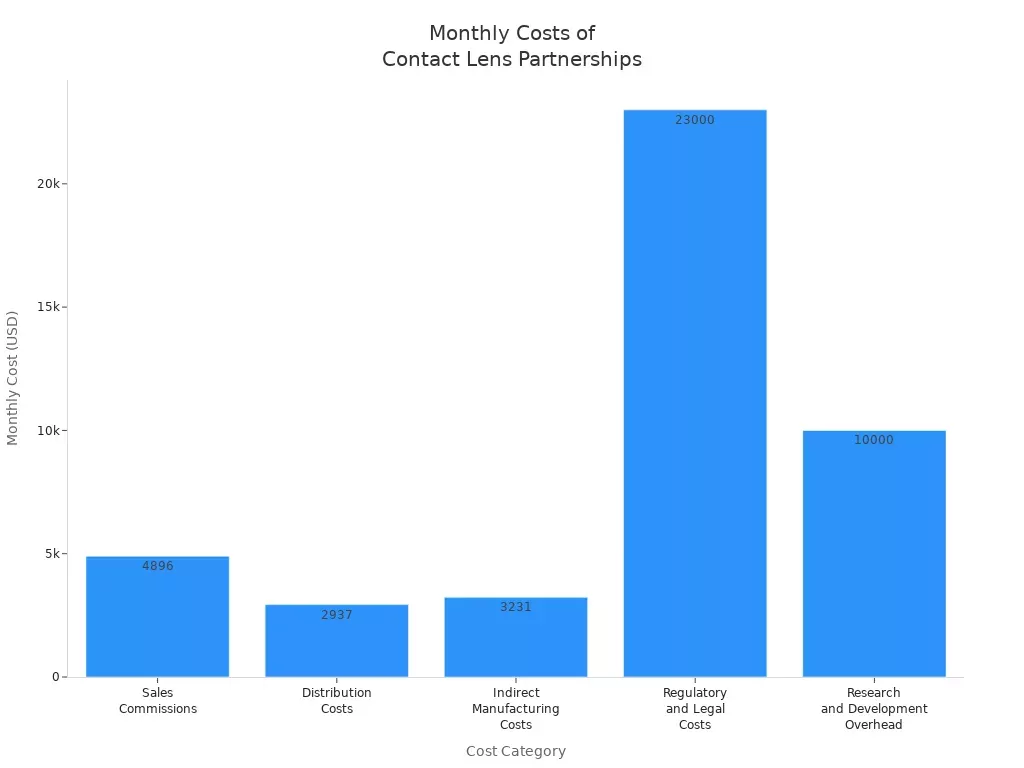
You also need to think about costs. Making contact lenses costs a lot of money. You will pay for sales commissions, distribution, making the lenses, legal fees, and research. Here is a chart that shows average monthly costs for a new contact lens brand:
Note: Always ask for samples and try to visit the factory. This helps you trust your partner and avoid problems later.
Ensure Product Quality and Safety
You want your customers to trust your contact lens brand. You must follow strict safety rules. In the United States, the FDA calls contact lenses medical devices. Most soft lenses are class II, which means moderate risk. Some special lenses are class III, which means high risk. You need to know which class your lenses are in.
Class | Risk Level | Examples |
II | Moderate | Daily wear hydrogel, rigid gas-permeable, hybrid, scleral lenses |
III | High | Extended wear soft, rigid gas-permeable, orthokeratology lenses, daily wear myopia control lenses |
Testing is very important for safe lenses. You must check for things like:
Permanent vision loss or serious eye reactions
How comfortable the lens feels over time
How well the lens keeps vision clear
Signs of dryness or irritation
You should test your lenses on many different people. Make sure you include different ages, genders, and backgrounds. For extended wear lenses, you need at least one year of testing with hundreds of users. Always compare your lens to a safe lens.
Safety first! Never skip testing. Good results mean happy, healthy customers and a strong brand.
Legal and Regulatory Compliance
You want your contact lens brand to do well. You also need to follow the law. Meeting legal rules keeps your business safe. It helps customers trust you. Let’s look at what you must do.
Obtain Certifications and FDA Approval
You need certifications before selling contact lenses. In the United States, the FDA sorts lenses by risk. Here’s what you need:
Classification Type | Requirements |
Class II Daily Wear Lenses | You need a Premarket Notification (510 K) document. |
Class III Extended-Wear Lenses | You must get Pre-Market Authorization (PMA) because these are higher risk. |
Investigational Device Exemption | Needed for studies on extended-wear lenses before starting the study. |
Institutional Review Board Approval | Needed for both daily and extended-wear lens studies. |
You must prove your lenses are safe and work well. Clinical testing is required. This helps you avoid problems. It keeps your contact lens profits strong.
Register Your Contact Lens Business
You must register your business in every market. Here’s what you should know:
Requirement | Description |
Compliance with MDR 2017 | Follow Medical Device Rules for making and selling lenses. |
ISO Certification | Get ISO 13485 to show your quality management meets global standards. |
Safety & Efficacy Testing | Prove your lenses are safe and work well through clinical tests. |
Labelling and Packaging | Follow strict rules for labels, including usage, expiration, and manufacturer details. |
Tip: Good compliance helps your business make more money. It keeps your brand’s reputation strong.
Packaging, Labeling, and Prescription Laws
You must label your contact lens products correctly. This keeps users safe. It helps you avoid legal trouble.
Regulation Source | Key Requirements |
FDA | Warn about infection risks, give clear instructions, and show clinical study results. |
CDSCO | List product name, maker info, usage, expiration, batch number, price, and storage instructions. |
Always check prescriptions with the patient’s doctor. This protects eye health. It keeps your business legal.
Never sell lenses without checking the prescription. Sellers who skip this step put customers at risk.
Following these rules keeps your contact lens business safe. It helps you make more money.
Branding, Distribution, and Contact Lens Marketing
Build Your Brand Identity
You want your contact lens brand to be noticed. Start by making a style that matches what you believe in. Pick a logo and colors that people will remember. Use the same way of talking everywhere, like on your website and social media. This helps people trust your brand. You can work with other brands or eye doctors to show you care about quality and new ideas. Always think about what your customers want. Give them advanced contact lens choices and great service.
Always use the same brand voice in your ads.
Work with trusted companies to help people trust you.
Make a logo and colors that your customers will like.
Show that you care about your customers’ eye health.
Create Packaging and User Instructions
Good packaging makes your brand look professional. Pick designs that are easy to open and store. Try to use eco-friendly materials. Many people want packaging that is good for the planet. Add clear instructions so users know how to wear and care for their lenses. This helps stop mistakes and keeps your customers happy.
Tip: Simple instructions and green packaging can make your brand special.
Develop Distribution Channels
You need to get your contact lens products to buyers. Use different ways to reach more people. Here are the most common ways:
Distribution Channel | Description |
Online Stores | Easy to shop and compare many products. |
Optical Stores | Give expert help and fitting services. |
Retail Pharmacies | Let people buy lenses with other health items. |
Specialty Stores | Focus on high-end products and special care. |
Using more than one channel can help your brand grow and make more money.
Contact Lens Marketing Strategies
Smart marketing helps you find new customers and keep old ones. Use the same branding everywhere so people remember you. Share posts on Facebook, Instagram, and Twitter to talk to buyers. Make your website easy to use and show your products. Give deals and discounts during holidays to get more sales. Try pay-per-click ads to bring more visitors. Remind people to get eye exams and offer direct shipping for ease. These steps can make your marketing strong and help your brand grow.
Note: It can cost about $50 to get a new customer, so make sure to keep your current customers happy too.
Operations and Customer Service
Manage Inventory and Fulfillment
You want your contact lens management to run smoothly. Keeping the right lenses in stock helps you avoid lost sales and keeps customers happy. Use smart tools to track what sells best. For example, you can use ChatGPT to look at past sales and predict what you need to order next. This helps you keep popular lenses on your shelves and avoid wasting money on slow sellers.
When you set up your contact lens management system, focus on these best practices:
Set clear prices for each box of lenses. Patients like to know the cost up front.
Offer discounts for bulk orders. This encourages people to buy more at once.
Make sure your fees match what other stores charge.
Write down each prescription clearly. This builds trust and helps with reorders.
Give patients a lens agreement. This explains how to care for and replace their lenses.
You can also join an online marketplace. This lets customers order lenses easily and helps you compete with big online stores. Good contact lens management means you always have what people want, and you make the buying process simple.
Provide Customer Support
Great customer service keeps people coming back. If you make it easy to order and get help, your brand will stand out. Here are some common reasons customers leave:
Challenge Type | Percentage | Description |
Office hours/location | 33% | Customers want easy access and flexible hours. |
Customer service | 27% | Friendly, helpful support makes a big difference. |
Ease of ordering | 20% | Complicated steps push people to other brands. |
You might also see problems like damaged lenses or poor care. These can cause eye irritation or infections. Always listen to customer concerns and fix problems fast. Good contact lens management means you answer questions quickly and help with any issues.
To see how well you are doing, track these numbers:
Metric | Description |
Repeat Customer Rate | Shows how many people buy from you again. |
Customer Acquisition Cost | Tells you how much you spend to get new buyers. |
Visitor Conversion Rate | Measures how many visitors become buyers. |
Average Order Value | Shows how much people spend each time. |
Gross Margin Percentage | Tells you how much profit you make. |
Happy customers will tell their friends about your brand. Good support and easy ordering help your contact lens business grow.
You’ve learned how to launch your own contact lens brand. Success starts with following rules, offering comfort, and keeping costs fair. Check out this quick table:
Key Considerations | Description |
Compliance | Make sure patients follow wearing schedules and care instructions. |
Comfort | Give lenses that fit well and feel good for long wear. |
Cost | Help patients choose lenses that fit their budget. |
Want to build a strong brand? Try these strategies:
Use your existing brand to build trust, like Warby Parker did.
Connect with your audience and offer both glasses and contacts for convenience.
Keep your eyes on these factors for long-term growth:
Factor | Explanation |
Customer Acquisition Cost | Lower costs to boost profits, especially with subscriptions. |
Retention Rate | Keep customers coming back for repeat sales. |
Customer Lifetime Value | Invest in new tech to meet changing needs and grow value over time. |
Ready to take action? Start your journey, focus on quality, and make your brand stand out. You can do this!
FAQ
How long does it take to launch a contact lens brand?
You can expect the process to take 12 to 24 months. This includes research, product development, testing, and getting all the needed approvals. Planning ahead helps you avoid delays.
Do I need FDA approval to sell contact lenses in the US?
Yes, you must get FDA approval before you sell any contact lens in the United States. This keeps your business legal and protects your customers’ eye health.
What is the minimum order size when working with manufacturers?
Most manufacturers ask for a minimum order. This number can range from 5,000 to 10,000 boxes. You should ask your partner about their exact requirements before you start.
Can I sell contact lenses online?
Yes, you can sell online. You must follow all prescription laws and check each order. Make sure your website is easy to use and gives clear instructions for buyers.
How do I handle customer complaints about lens comfort?
Listen to your customers and respond quickly. Offer a replacement or refund if needed. Always ask for details about the problem so you can improve your products and service.